


As the year approaches an end, I think about what I’ve achieved: apart from the daily rhythms that involve managing a home with four adults living in it; teaching young people how to be creative writers; and trying to be active, eat well, sleep enough and spend as much time as possible with the special people in my life. Though I don’t always succeed, I try my best to fit it all in.
As if that wasn’t enough to keep me out of mischief, my third memoir, Twelve Golden Gifts, was released in late August. It seems that try as I might, I can’t write anything other than my life. Perhaps it’s a failure of the imagination. Or that modern Western malady: an obsession with self. It may well be a love affair with elevating the mundane minutiae of daily life into something that resembles grace. Whatever the reason, writing memoir makes me feel that my life, just like everyone else’s, matters.
Twelve Golden Gifts is the story of caring for our mother Chrisoula in her four-year journey with dementia. It is a tribute to her, and a love letter of sorts. It is a wail and a lament. But most of all it is a celebration of all the gifts she gave my family and I when she was alive – and how they helped us care for her and continue her legacy now that she is gone.
Many of the words in Twelve Golden Gifts were written on scraps of paper at stop lights, on my laptop in the snatched minutes before I got out of bed, and on my phone while Mum napped in hospital rooms and care homes. Some were overheard conversations, some intimate diary entries, and many were a record of quirky chats with Mum, which usually ended in laughter.
Writing things down has always helped me process emotionally charged events. Letters to Mum, even if she was never to read them, poems, and journal entries, all served to help me cope during this difficult time. Writing was also a way to capture my mother’s words—and when she no longer had many of these, her spirit.
Deciding to share some of these words, and to write many others for Twelve Golden Gifts following Mum’s death, was not an easy decision to make. Selfishly perhaps, I wanted to keep her alive for longer. I yearned to bed down her sparkling spirit for posterity, a little like a parent hankers to bottle the smell of their newborn. Ultimately, I told myself that if our story could help even one person feel less alone through caring for someone with dementia, then it would be worth sharing.
The first step was to put the scraps of writing together in one document. When I saw that they added up to 80,000 words, I felt I might have enough for a book. During the summer break a few months after Mum’s death, I penned a book proposal. I knew if I didn’t do it sooner than later, I would lose my nerve. I still had a lot of unresolved guilt. I was very sad. I wasn’t sleeping. So even as I sent it off, I was secretly hoping it wouldn’t go anywhere.
My agent Jacinta Dimase pitched the proposal to several publishers. When HarperCollins Publishers Australia/ABC Books agreed to publish, my shoulders sank just a little. I knew it would be a big undertaking, despite the words that I’d already written. Would I have the strength to bring together this incredibly personal, revealing book? And how could I possibly do my cheeky, kind and generous mother justice without overexposing her?
Writer Anne Lamott said, ‘you need to start somewhere’ and so I sat down to try and make sense of the words I already had. Though I had more than most when it comes to writing a book, developing some sort of cohesive narrative was like trying to unravel a tangled piece of string. The timelines were confused, not just from month to month, but even from year to year. Time had elongated and contracted, and these difficult months of loss and fervent activity of caring had their own rhythms. The words I had written during Mum’s illness were all over the place. Putting them in some sort of chronological order in the months after she died was a way of unravelling the string. It was both strangely satisfying and deeply frustrating, therapeutic and triggering. I used documents, diaries and photographs to piece together the events and to clear up the muddled timelines. My work colleagues read first drafts; friends and family read the chapters that involved them; and organisations such as Dementia Australia, Older Persons Advocacy Network, Grief Australia and Palliative Care Victoria helped ensure that some of the advice I provided in the final chapter of the book was grounded and accurate.
As each chapter took form, and as the book miraculously fell into place, I found my way back to my mother: to the gifts she had given my family and I; to her incredible spirit as she battled with the disease that ultimately took her life; but especially to the woman she was before dementia took hold.
While promoting this book in recent months has sometimes felt like yet another emotional chopping block, it feels worth it to get this book into the right hands. I was giving a talk at a local library recently. A women told me she was looking after her mother with dementia. She was halfway through my book, apologised that she hadn’t yet finished it before coming along. With a shaky voice, she said that caring for someone with dementia felt so isolating. That it was validating to have some of her experiences reflected back at her through our story. And that my book was a gift.
Even if I’d made only one person feel this way, then I’d achieved what I set out to do.
Purchase Twelve Golden Gifts in Australia at all good bookshops, or order from Booktopia.
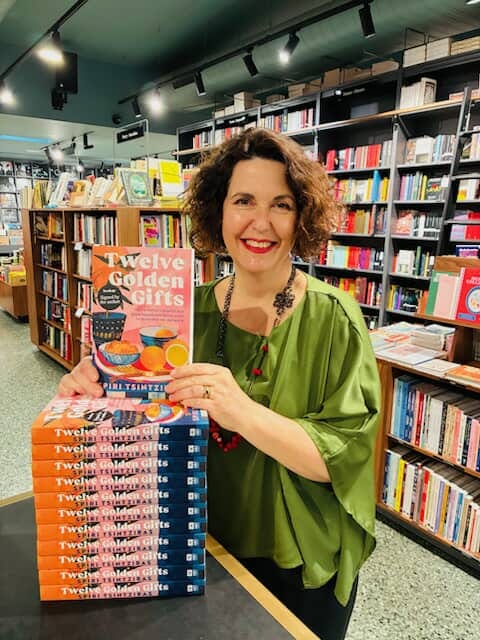
Author Spiri Tsintziras at Readings Carlton.
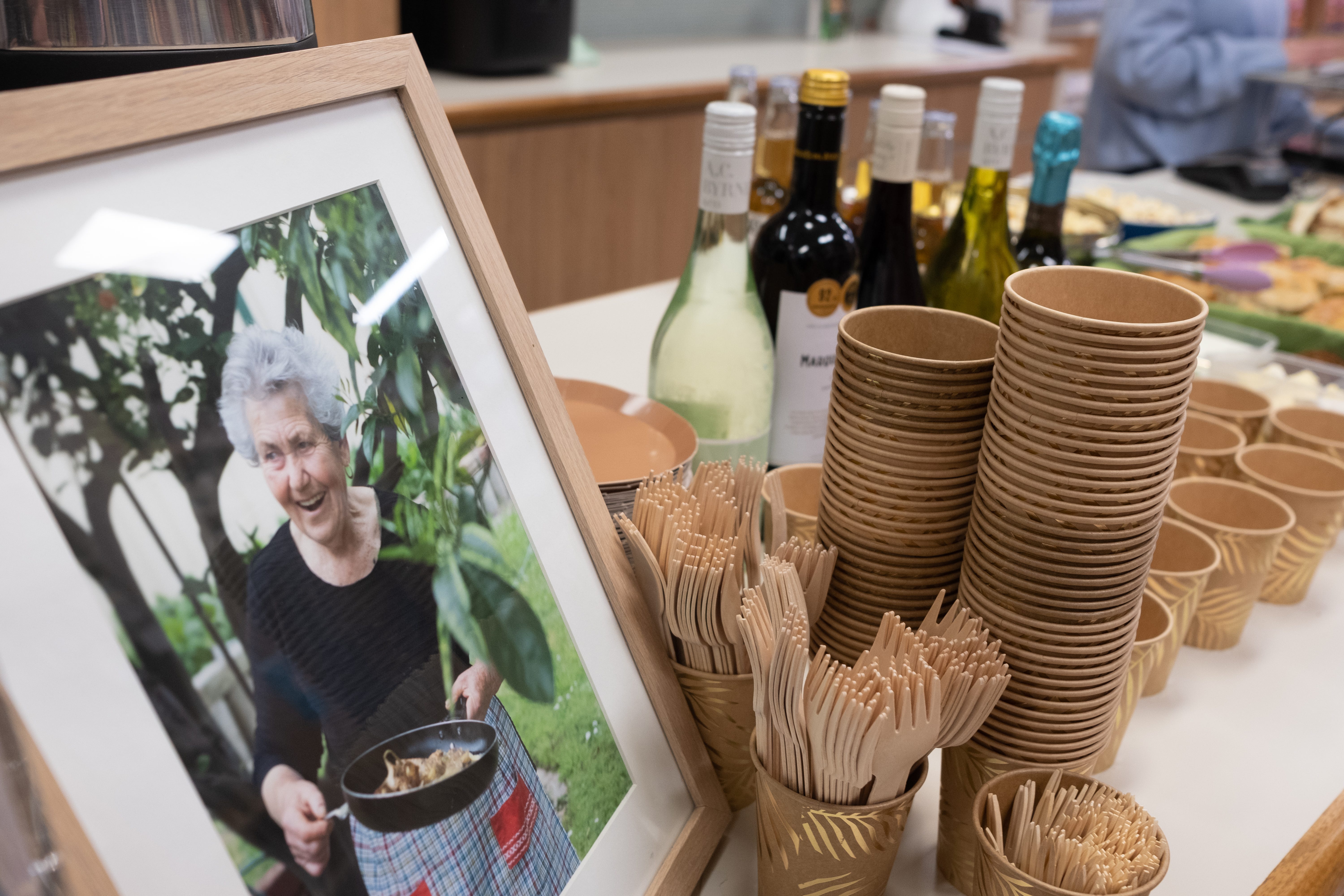
A photo of Mum in her garden taking pride of place at the launch/fundraiser of Twelve Golden Gifts at Escape Hatch Books. $2855 has been raised to date for Dementia Australia in Mum’s name.
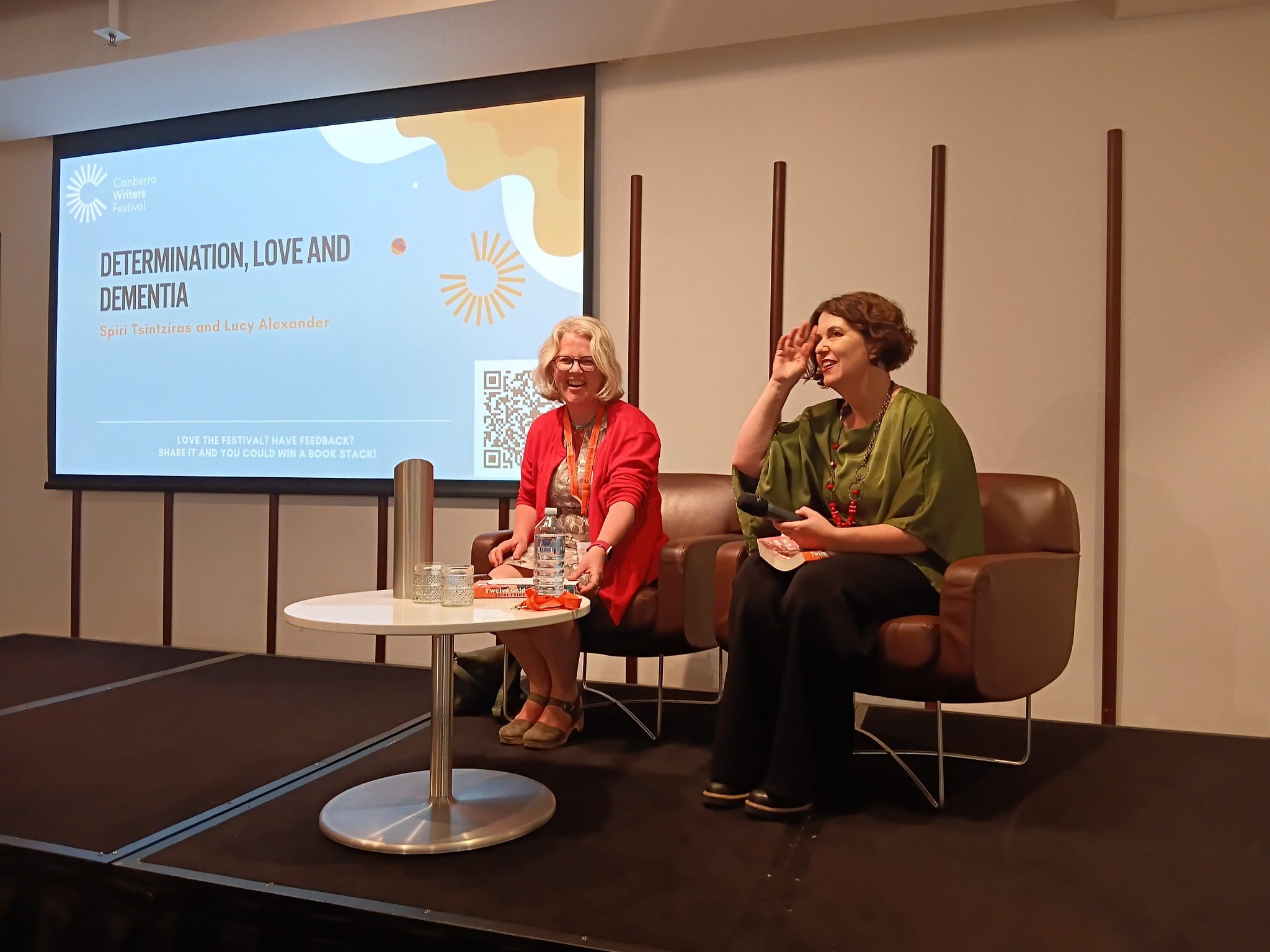
Writer Lucy Alexander in conversation with writer Spiri Tsintziras at 2025 Canberra Writers Festival.
Photo credits George Mifsud Photography.